

Not every tactic, strategy, or channel deserves a spot in your marketing bracket.
The firms that grow best know which ones deserve attention and which ones are actually driving revenue.
One Big Idea — Too Many Tactics, Not Enough Focus
Most advisory firms have more marketing ideas than they can realistically execute well. And just like you can't watch all 64 teams play in the tournament, you can't focus on 64 marketing tactics.
The real advantage comes from knowing which channels deserve your time, budget, and belief. Growth gets easier when you narrow the field and pay attention to what keeps winning.
Recent research points to a clear pattern. Referrals still matter. A lot. But they are no longer the only serious contender. Organic marketing, including content, SEO, and education-based outreach, is gaining ground fast. And even when a prospect is referred, they still tend to research the firm online before taking the next step.
Start by determining the different rounds of marketing tactics you've built around your firm, beginning with the Top 16.
TOP 16
Your top 16 might include things like:
- Referrals
- COI relationships
- Website
- SEO
- Educational content
- Email marketing
- Client events
- Webinars
- Online reviews
- Google Business Profile
- Social media
- Video
- Local search visibility
- Niche positioning
- Follow-up systems
- AI search visibility
Each one can help generate demand, build trust, or convert interest.
TOP 8
From there, your top 8 usually gets tighter. For most firms, that smaller group probably includes: referrals, COI partnerships, website, SEO, email, educational content, events, and follow-up.
Why those? Because they line up with how people actually choose an advisor. They hear about you from someone they trust, look you up, scan your credibility, consume a bit of your thinking, and decide whether to move forward.
TOP 4
Then your top 4 becomes clearer still. For many firms, it comes down to:
- Referrals
- Organic search and content
- Website
- Email or follow-up nurture
Referrals may open the door, but your digital presence often determines whether the opportunity keeps moving.
CURRENT CHAMPION?
For many firms, it's still referrals. But that answer should never be based on habit or assumption. It should be tracked.
In some firms, referrals still drive the most revenue. In others, organic marketing is gaining fast enough to challenge for the top spot.
CINDERELLA
There is also a newer contender starting to make a real run: AI search visibility. It may not be the top tactic for every firm today, but it's clearly one to watch.
So the lesson is simple. You don't need to run every possible marketing play. You do need to know which tactics belong in the field, which few deserve serious attention, and which one is actually winning for your firm.
Because most firms don't have a shortage of marketing options, they have a shortage of focus.
One Framework — The Marketing Matchup Scorecard
If your firm has too many tactics in play, don't ask, “What else should we add?”. Ask, “Which tactics are actually earning the right to advance?”
Put your main tactics head-to-head and score them against the metrics that matter most.
STEP 1: List your current contenders
Start with the tactics you're already using, or seriously considering. For example:
- Referrals
- COI partnerships
- Client events
- Email marketing
- SEO
- Educational content
- Social media
- Paid ads
- Webinars
- Google reviews
- AI search visibility
STEP 2: Score each tactic on five factors
Use a simple 1 to 5 scale.
- Lead Volume – How many real opportunities does this tactic generate?
- Lead Quality – How aligned are those leads with your ideal client?
- Conversion Rate – How often does this tactic lead to a meeting, consultation, or client?
- Cost & Effort – How much time, money, and team energy does it take to keep this tactic running?
- Revenue Influence – How much actual revenue can be tied back to this tactic, directly or indirectly?
STEP 3: Add one strategic factor
This keeps you from only rewarding what worked yesterday.
- Future Potential – Is this tactic growing in importance, even if it isn't your top performer yet?
This is where something like AI search visibility might score well. It may not be your top source today, but it could be building momentum.
STEP 4: Compare the totals
Once each tactic is scored, patterns usually become obvious. A few tactics will stand out as worth deeper investment. A few will stay in the mix, but at a lower priority. And a few will clearly not deserve another season.
STEP 5: Sort into three groups
This is where you narrow the field.
- Double Down – High-performing tactics that are generating leads, clients, or revenue efficiently.
- Develop – Promising tactics that need better execution, consistency, or time.
- Drop or Reduce – Tactics that drain time and budget without producing enough return.
Simple Example
A firm might discover:
- Referrals generate the highest-quality leads
- SEO and content bring in steady inbound traffic
- Email helps nurture opportunities already in motion
- Social media gets attention, but very few real conversations
- Events are valuable, but only when paired with strong follow-up
That changes the conversation.
Instead of saying, “We should probably post more,” the team starts saying, “Let’s invest more in the channels that are actually moving people toward becoming clients. ”
The goal isn't to run more tactics, it's to let the best ones keep advancing. . . all the way to the championship
One Resource — The Marketing Bracket Scorecard
The Marketing Bracket Scorecard is a simple one-page tool designed to help firms compare their current channels side by side, score them based on real business impact, and narrow the field to the few tactics that truly deserve more time, budget, and belief.
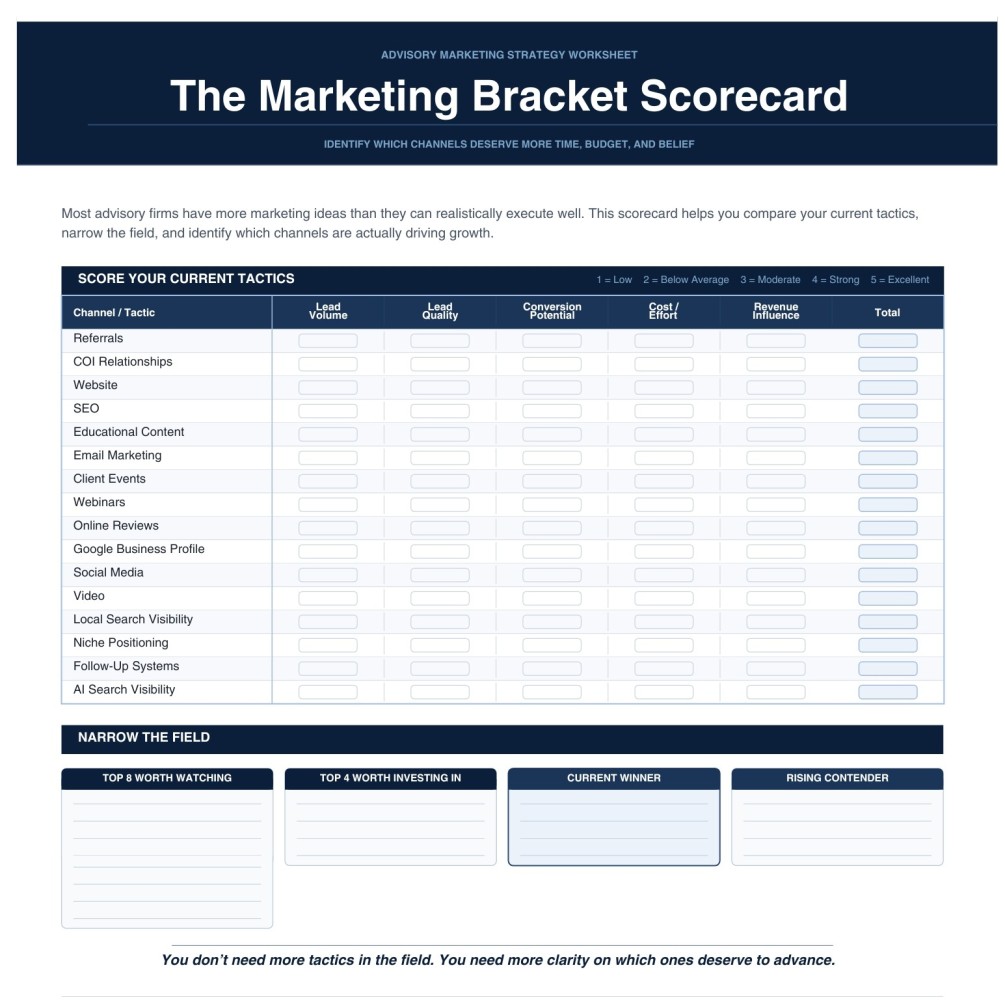
Instead of guessing which efforts are working, firms can use it to assess lead volume, lead quality, conversion potential, cost, and revenue influence across the tactics they are already using. That makes it easier to separate the channels that only create activity from the ones that actually create momentum.
If your firm has too many marketing plays in motion and not enough clarity on what is winning, this is a practical place to start.
One Next Step — Don't Shoot an Airball
Pull a list of every new client or qualified lead from the last 12 months and identify where each one came from. Then compare that to where your team is spending the most time, budget, and energy.
You may find that a small number of channels are responsible for far more momentum than the rest. You may also find that certain tactics get a lot of attention internally but are not producing much in return.
And if you aren't asking every lead where they heard about you, you're shooting an air ball. Attribution doesn't need to be perfect, but it does need to start somewhere.
Use that insight to narrow the field. Double down on the channels that are consistently creating opportunities, rethink the ones that are underperforming, and make sure your marketing effort matches the tactics that are actually helping your firm grow.