

In a testament to the importance and venerability of the S&P 500, the three largest US-listed exchange traded funds each track that index.
In order of assets under management, those products are the Vanguard S&P 500 ETF (NYSE: VOO), the SPDR S&P 500 ETF Trust (NYSE: SPY) – the oldest ETF in this country – and the iShares Core S&P 500 ETF (NYSE: IVV). Combined, that trio controls approximately $1. 8 trillion in assets under management, or about the same size as Mexico’s GDP.
Yet, there’s an ETF that tracks the cap-weighted S&P 500 – the same gauge followed by IVV, SPY and VOO – that leads a relatively anonymous existence: the SPDR Portfolio S&P 500® ETF (NYSE: SPLG). In simple terms, SPLG is the more cost-effective, more buy-and-hold-investor-friendly counterpart to SPY. More on the cost issue later.
SPLG was rebranded in 2020, but it has just $63 million in assets under management. Odd for any number of reasons, not the least of which is precedent for issuers finding success with ETFs designed to be cheap, long-term counterparts to older, well-known products.
SPLG Has a Cost Advantage
One of the big reasons VOO usurped SPY in terms of size is because the former is less expensive than the latter. The Vanguard S&P 500 ETF charges just 0. 03% per year, or $3 on a $10,000 stake, compared to SPY’s still low 0. 09%.
That gap persists because SPY is largely a tool for short-term traders and other, more glamorous market participants, such as hedge funds and high-frequency trading shops. Conversely, VOO is beloved by advisors and retail investors because of its low annual expense ratio.
There’s nothing wrong with that sentiment, but if fund fees matter – they do – and each basis point saved is a win for clients and investors – then SPLG deserves more fanfare simply because its expense ratio is 0. 02%, or below what’s found on VOO.
In fact, SPLG is in a tie with another broad market domestic equity fund for the honor of second-cheapest US-listed ETF. There are some, many with temporary fee waivers, that don’t levy yearly expenses. Additionally, SPLG should be a fan favorite among price-conscious retail investors. The SPDR ETF closed at $65. 74 on May 6 while the average closing print for IVV and VOO on the same day was $537. Translation: SPLG does the same thing as its larger rivals with a lower fee AND a lower price tag.
SPLG for the Long-Term
For those deciding between SPY and SPLG, the answer is easy. It boils down the holding period. If it’s just a few days, SPY’s revered liquidity makes that the preferred option. A holding period of months or years makes SPLG the winning idea.
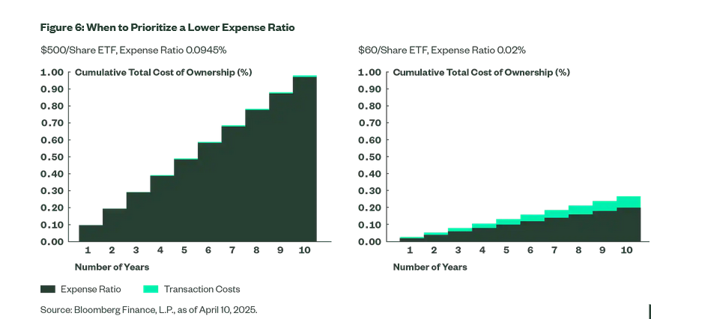
(Image Courtesy: State Street Global Advisors (SSGA))
“You might have a 10-year time horizon and rebalance 10% of your position quarterly,” notes SSGA. “If we assess the total cost of ownership between the same ETF at $500/share with an expense ratio of 0. 0945% and an ETF at $60/share with an expense ratio of 0. 02% where both funds trade with $0. 01 bid-ask spread — again, assuming no change in market price, and no additional tracking difference between these two funds — you would pay less in total cost with the lower priced ETF, despite greater transaction costs. ”
That also means SPLG saves clients and investors money not only when compared to SPY, but also to IVV and VOO, too.